

Insights
Soundproofing vs Acoustic Treatment: What Is the Difference and Which One Do You Need?
Soundproofing and acoustic treatment are two of the most commonly confused concepts in building acoustics. They solve completely different problems, require completely different approaches, and confusing one for the other is one of the most expensive mistakes you can make in a fit-out or renovation.
The two terms get used interchangeably constantly, in product marketing, in contractor proposals, in conversations with clients who know something is wrong with their space but are not sure what. Soundproofing and acoustic treatment. They sound related. They are not the same thing, and confusing them leads to spending money on the wrong solution.
What Soundproofing Actually Means
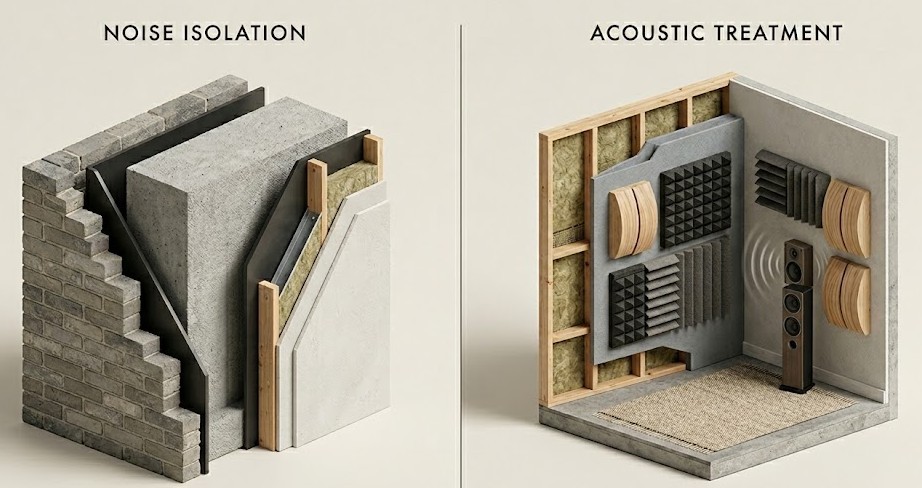
Soundproofing, more accurately called sound isolation or noise isolation, is about stopping sound from travelling between two spaces. The goal is to prevent noise generated in one room from being heard in another, or to prevent external noise from entering a space. This is a structural problem. It is solved by mass, by decoupling structural connections, and by eliminating gaps and weak points in the building envelope. A heavy dense wall stops more sound than a light one. A floor with a resilient layer decoupled from the structure transmits less impact noise than one rigidly connected to the slab. A door with an airtight seal performs significantly better than one with a gap at the threshold.
Soundproofing cannot be achieved by adding soft materials to the surfaces of an existing room. Foam panels, fabric wall coverings and acoustic tiles do not stop sound from travelling between spaces. They absorb sound energy within the room they are installed in, which is a completely different function. A room lined with acoustic foam is not soundproofed. It is acoustically treated.
What Acoustic Treatment Actually Means
Acoustic treatment is about controlling how sound behaves within a room. The goal is not to stop sound from entering or leaving but to optimise the acoustic environment inside the space itself. The primary tools are absorption, which reduces reverberation and echo by converting sound energy into heat, diffusion, which scatters sound to create a more even distribution of energy in the room, and in some cases bass trapping, which addresses the low frequency modal behaviour that causes booming and uneven bass response in small rooms.
Acoustic treatment is what makes a meeting room easier to have a conversation in. It is what makes a restaurant less fatiguing to sit in for two hours. It is what makes a recording studio sound controlled and accurate rather than coloured by the room itself. It does not prevent noise from the corridor outside entering the room. It does not stop music from leaking into the apartment next door. Those are soundproofing problems.
Why Confusing Them Is Expensive
The confusion between these two concepts has real financial consequences and is one of the most common sources of wasted expenditure in fit-outs and renovations. A restaurant owner who installs acoustic panels because the room is too loud will improve the reverberation time and reduce the perceived loudness of the space. That is acoustic treatment working correctly. But if the complaint was that music from the restaurant is disturbing the office upstairs, the panels will have no effect whatsoever on that problem. That is a soundproofing problem and it requires a structural solution.
A homeowner who lines a room with foam panels because they want to practice drums without disturbing the neighbours will be disappointed. The foam treats the acoustic environment inside the room. It does almost nothing to reduce the noise that travels through the walls, floor and ceiling to adjacent spaces. The neighbours will still hear the drums. The room will just sound less live while they do.
A developer who specifies acoustic ceiling tiles throughout an apartment building because they want to address noise complaints between units is solving the wrong problem. The ceiling tiles improve room acoustics. The noise complaints are about sound travelling between apartments, which is a structural insulation problem that ceiling tiles cannot address.
Which One Do You Actually Need?
The answer depends entirely on what problem you are trying to solve. If the problem is that noise from outside is entering your space, or that sound generated in your space is disturbing people in adjacent spaces, you have a soundproofing problem. The solution involves structural modifications, additional mass, decoupling of structural connections, or sealing of acoustic weak points. This work is most effective and most cost efficient when done at the design or construction stage.
If the problem is that your space sounds poor for its intended use, speech is unclear, music sounds muddy, the room is too reverberant or too echo prone, you have an acoustic treatment problem. The solution involves absorptive and diffusive materials applied to the room surfaces, with the specific approach depending on the room dimensions, the surface areas available and the acoustic target for the space.
Many spaces need both. A recording studio needs structural isolation from the outside world and careful acoustic treatment of the interior. A hotel bedroom needs sound insulation between rooms and a controlled reverberation time within the room itself. A meeting room needs both adequate partition performance against the adjacent corridor and a reverberation time short enough for clear speech.
Why Getting the Diagnosis Right Matters
The reason these two concepts get confused is that both involve the word acoustic and both relate to how sound behaves in a building. But they operate on completely different physical principles and require completely different interventions. Getting the diagnosis right before specifying any solution is the most important step in any acoustic project. An independent acoustic consultant has no interest in selling you a particular product or material. The job is to identify what problem you actually have, explain what type of solution addresses it, and specify that solution to a measurable performance target.
If you are unsure whether your space has a soundproofing problem, an acoustic treatment problem, or both, get in touch for an initial conversation.
Ελληνική Περίληψη
Η ηχομόνωση και η ακουστική επεξεργασία χώρου είναι δύο εντελώς διαφορετικές έννοιες που συχνά συγχέονται. Η ηχομόνωση αφορά την αποτροπή μετάδοσης ήχου μεταξύ χώρων και απαιτεί δομικές παρεμβάσεις με μάζα και αποσύνδεση κατασκευαστικών στοιχείων. Η ακουστική επεξεργασία αφορά τη βελτίωση της ακουστικής συμπεριφοράς εντός ενός χώρου μέσω απορροφητικών και διαχυτικών υλικών. Η σύγχυση των δύο οδηγεί σε δαπάνες για λανθασμένες λύσεις. Η σωστή διάγνωση του προβλήματος πριν από οποιαδήποτε απόφαση είναι το πιο σημαντικό βήμα.
Connect
info@nodeacoustics.com
(+357) 99 718622
" width="89px"><path d="M 45.427 0 C 42.448 0 40.214 2.209 40.214 5.155 C 40.214 8.1 42.448 10.31 45.427 10.31 C 48.405 10.31 50.64 8.1 50.64 5.155 C 50.64 2.209 48.405 0 45.427 0 Z M 21.969 6.628 C 9.681 6.628 0 16.569 0 28.351 C 0 40.134 10.053 50.075 21.969 50.075 C 33.884 50.075 43.937 40.134 43.937 28.351 C 43.937 16.569 34.256 6.628 21.969 6.628 Z M 21.969 42.343 C 14.149 42.343 7.819 36.084 7.819 28.351 C 7.819 20.619 14.149 14.36 21.969 14.36 C 29.788 14.36 36.118 20.619 36.118 28.351 C 36.118 36.084 29.788 42.343 21.969 42.343 Z" fill="rgb(153, 153, 153)" height="50.07531380753138px" id="VSj3XsHuK" transform="translate(22.698 16.216)" width="50.63951740598173px"/><path d="M 62.555 0 L 27.182 0 C 11.915 0 0 11.782 0 26.51 L 0 61.49 C 0 76.218 11.915 88 26.809 88 L 62.182 88 C 77.076 88 88.992 76.218 88.992 61.49 L 88.992 26.51 C 89.364 11.782 77.449 0 62.555 0 Z M 80.8 61.858 C 80.8 71.799 72.608 80.268 62.182 80.268 L 26.809 80.268 C 16.756 80.268 8.192 72.167 8.192 61.858 L 8.192 26.879 C 8.192 16.937 16.383 8.469 26.809 8.469 L 62.182 8.469 C 72.236 8.469 80.8 16.569 80.8 26.879 Z" fill="rgb(153, 153, 153)" height="88px" id="w6VARJ_5D" width="89px"/></g></svg>)
" width="78px"/><path d="M 19.5 24.375 L 19.5 9.75 C 19.5 4.365 15.135 0 9.75 0 C 4.365 0 0 4.365 0 9.75" fill="transparent" height="24.375px" id="bvurMyrXC" stroke-dasharray="" stroke-linecap="round" stroke-linejoin="round" stroke-width="8.73" stroke="rgb(153, 153, 153)" transform="translate(39 34.125)" width="19.500000000000142px"/></g></svg>)
Location
Limassol, Cyprus
Insights
Soundproofing vs Acoustic Treatment: What Is the Difference and Which One Do You Need?
Soundproofing and acoustic treatment are two of the most commonly confused concepts in building acoustics. They solve completely different problems, require completely different approaches, and confusing one for the other is one of the most expensive mistakes you can make in a fit-out or renovation.
The two terms get used interchangeably constantly, in product marketing, in contractor proposals, in conversations with clients who know something is wrong with their space but are not sure what. Soundproofing and acoustic treatment. They sound related. They are not the same thing, and confusing them leads to spending money on the wrong solution.
What Soundproofing Actually Means
Soundproofing, more accurately called sound isolation or noise isolation, is about stopping sound from travelling between two spaces. The goal is to prevent noise generated in one room from being heard in another, or to prevent external noise from entering a space. This is a structural problem. It is solved by mass, by decoupling structural connections, and by eliminating gaps and weak points in the building envelope. A heavy dense wall stops more sound than a light one. A floor with a resilient layer decoupled from the structure transmits less impact noise than one rigidly connected to the slab. A door with an airtight seal performs significantly better than one with a gap at the threshold.
Soundproofing cannot be achieved by adding soft materials to the surfaces of an existing room. Foam panels, fabric wall coverings and acoustic tiles do not stop sound from travelling between spaces. They absorb sound energy within the room they are installed in, which is a completely different function. A room lined with acoustic foam is not soundproofed. It is acoustically treated.
What Acoustic Treatment Actually Means
Acoustic treatment is about controlling how sound behaves within a room. The goal is not to stop sound from entering or leaving but to optimise the acoustic environment inside the space itself. The primary tools are absorption, which reduces reverberation and echo by converting sound energy into heat, diffusion, which scatters sound to create a more even distribution of energy in the room, and in some cases bass trapping, which addresses the low frequency modal behaviour that causes booming and uneven bass response in small rooms.
Acoustic treatment is what makes a meeting room easier to have a conversation in. It is what makes a restaurant less fatiguing to sit in for two hours. It is what makes a recording studio sound controlled and accurate rather than coloured by the room itself. It does not prevent noise from the corridor outside entering the room. It does not stop music from leaking into the apartment next door. Those are soundproofing problems.
Why Confusing Them Is Expensive
The confusion between these two concepts has real financial consequences and is one of the most common sources of wasted expenditure in fit-outs and renovations. A restaurant owner who installs acoustic panels because the room is too loud will improve the reverberation time and reduce the perceived loudness of the space. That is acoustic treatment working correctly. But if the complaint was that music from the restaurant is disturbing the office upstairs, the panels will have no effect whatsoever on that problem. That is a soundproofing problem and it requires a structural solution.
A homeowner who lines a room with foam panels because they want to practice drums without disturbing the neighbours will be disappointed. The foam treats the acoustic environment inside the room. It does almost nothing to reduce the noise that travels through the walls, floor and ceiling to adjacent spaces. The neighbours will still hear the drums. The room will just sound less live while they do.
A developer who specifies acoustic ceiling tiles throughout an apartment building because they want to address noise complaints between units is solving the wrong problem. The ceiling tiles improve room acoustics. The noise complaints are about sound travelling between apartments, which is a structural insulation problem that ceiling tiles cannot address.
Which One Do You Actually Need?
The answer depends entirely on what problem you are trying to solve. If the problem is that noise from outside is entering your space, or that sound generated in your space is disturbing people in adjacent spaces, you have a soundproofing problem. The solution involves structural modifications, additional mass, decoupling of structural connections, or sealing of acoustic weak points. This work is most effective and most cost efficient when done at the design or construction stage.
If the problem is that your space sounds poor for its intended use, speech is unclear, music sounds muddy, the room is too reverberant or too echo prone, you have an acoustic treatment problem. The solution involves absorptive and diffusive materials applied to the room surfaces, with the specific approach depending on the room dimensions, the surface areas available and the acoustic target for the space.
Many spaces need both. A recording studio needs structural isolation from the outside world and careful acoustic treatment of the interior. A hotel bedroom needs sound insulation between rooms and a controlled reverberation time within the room itself. A meeting room needs both adequate partition performance against the adjacent corridor and a reverberation time short enough for clear speech.
Why Getting the Diagnosis Right Matters
The reason these two concepts get confused is that both involve the word acoustic and both relate to how sound behaves in a building. But they operate on completely different physical principles and require completely different interventions. Getting the diagnosis right before specifying any solution is the most important step in any acoustic project. An independent acoustic consultant has no interest in selling you a particular product or material. The job is to identify what problem you actually have, explain what type of solution addresses it, and specify that solution to a measurable performance target.
If you are unsure whether your space has a soundproofing problem, an acoustic treatment problem, or both, get in touch for an initial conversation.
Ελληνική Περίληψη
Η ηχομόνωση και η ακουστική επεξεργασία χώρου είναι δύο εντελώς διαφορετικές έννοιες που συχνά συγχέονται. Η ηχομόνωση αφορά την αποτροπή μετάδοσης ήχου μεταξύ χώρων και απαιτεί δομικές παρεμβάσεις με μάζα και αποσύνδεση κατασκευαστικών στοιχείων. Η ακουστική επεξεργασία αφορά τη βελτίωση της ακουστικής συμπεριφοράς εντός ενός χώρου μέσω απορροφητικών και διαχυτικών υλικών. Η σύγχυση των δύο οδηγεί σε δαπάνες για λανθασμένες λύσεις. Η σωστή διάγνωση του προβλήματος πριν από οποιαδήποτε απόφαση είναι το πιο σημαντικό βήμα.
Connect
info@nodeacoustics.com
(+357) 99 718622
Location
Limassol, Cyprus