

Case Study
The Glass Meeting Room: A Simulation Study in Why Diagnosis Comes Before Treatment
We modelled an untreated glass meeting room from the ground up. This is what the data showed, why standard treatment approaches fall short, and what the right process actually looks like.
Glass meeting rooms are one of the most acoustically problematic spaces
in modern office design. They are also one of the most common. When they
perform poorly, the typical response is to add some acoustic panels and
hope the problem improves. It usually doesn't. This simulation study
examines why.
The Study
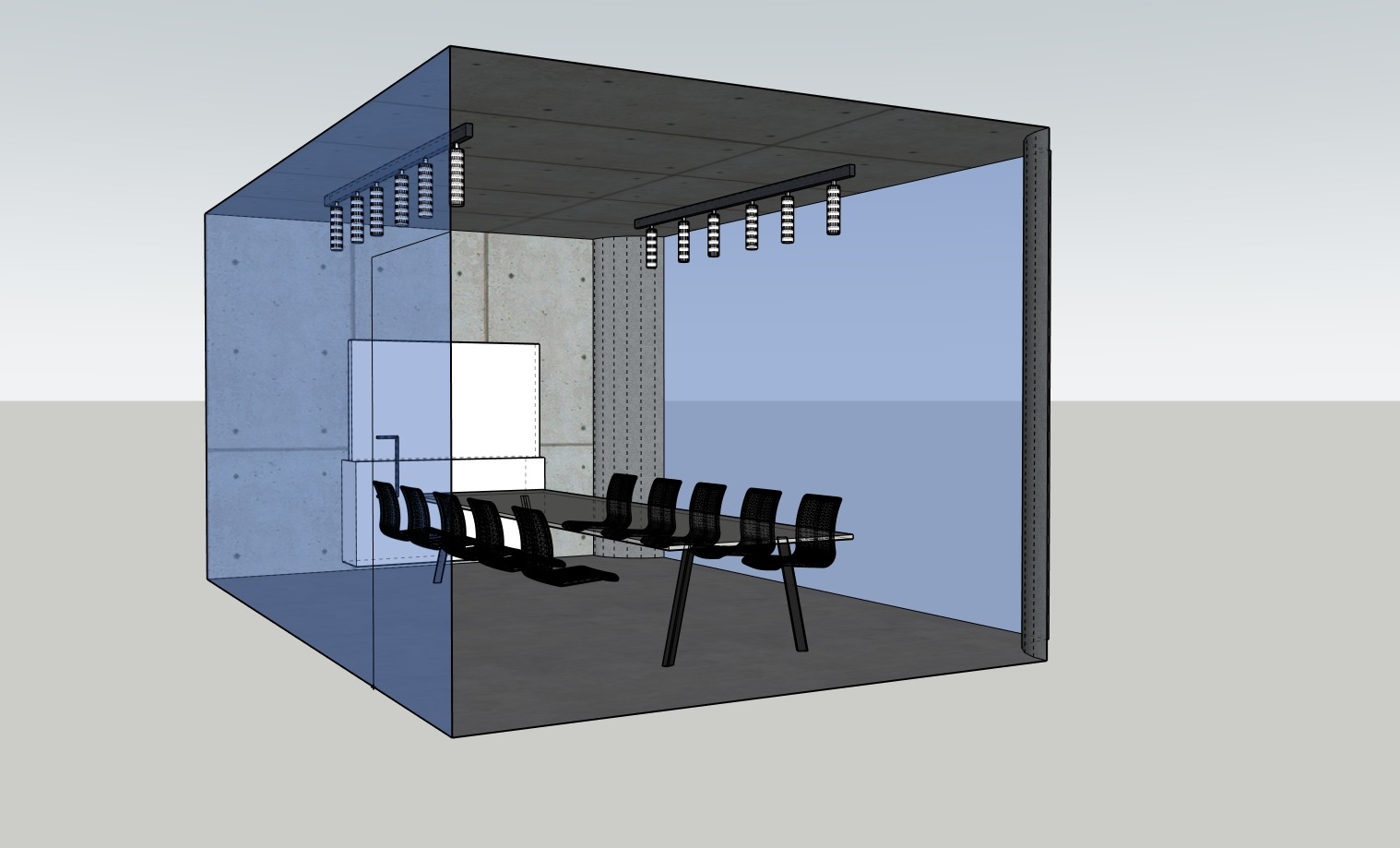
We built a computational acoustic model of a typical untreated glass
meeting room. 3 metres wide, 5 metres long, glass walls, concrete ceiling,
hard floor. Using a hybrid simulation approach combining pressure acoustics
at low frequencies and geometric ray tracing at mid and high frequencies,
we extracted a full set of acoustic metrics across the audible frequency
range.
The goal was not to confirm that the room sounds bad. That was already
predictable. The goal was to understand precisely what is happening
acoustically and why, because that distinction determines what an effective
solution actually looks like.
What the Data Shows
Reverberation time is well above the target
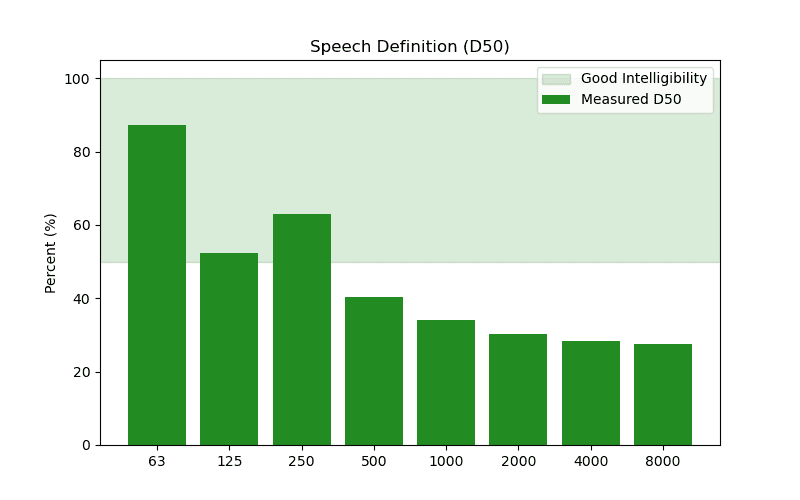
For a meeting room used primarily for speech, reverberation time should
sit between 0.4 and 0.6 seconds. The simulation returned values between
2.0 and 2.6 seconds across mid and high frequencies. That is roughly four
to five times longer than it should be.
At that level every spoken word overlaps with the decay tail of the
previous one. Speech becomes smeared and increasingly difficult to follow,
particularly on video calls where microphones pick up the reverberant
tail and transmit it to remote participants. The room is actively working
against every conversation held inside it.
Early Decay Time confirms what people feel
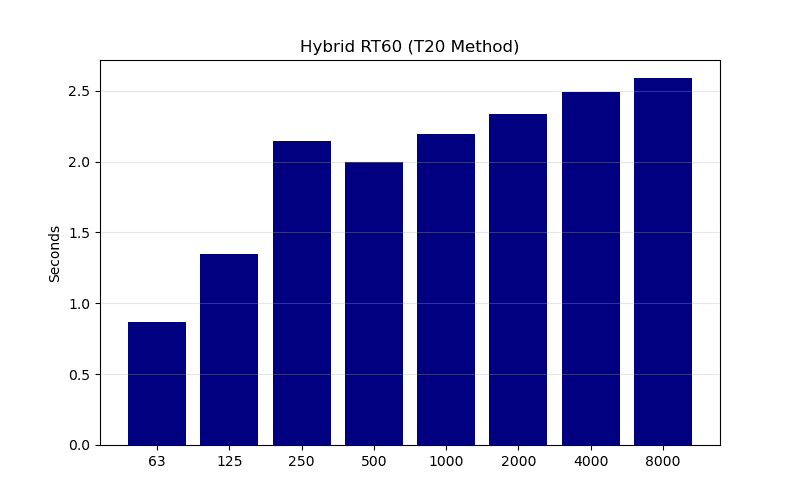
Early Decay Time reflects how reverberant a space actually feels to the
people inside it, separate from what the instruments measure. Values in
the simulation rose from around 1.1 seconds at 125 Hz to over 2.2 seconds
at high frequencies. Concert halls designed for a rich enveloping musical
experience are built to those values. A meeting room should not sound like
a concert hall.
Speech definition falls below the threshold for intelligibility
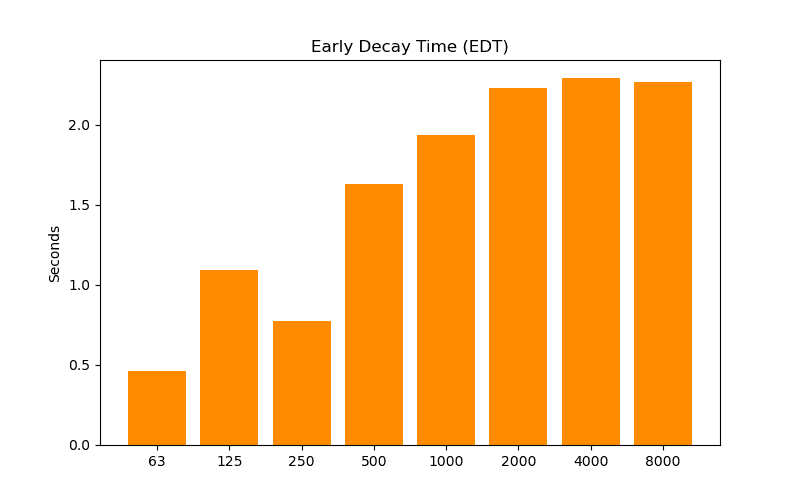
D50 measures the proportion of sound energy arriving within the first
50 milliseconds of a sound event, which ties directly to how well speech
can be understood. Values above 50% are generally considered acceptable
for speech. The simulation returned approximately 40% at 500 Hz, falling
below 30% from 1000 Hz upward. That is the frequency range carrying most
of the information in human speech. The room is failing at exactly the
frequencies that matter most for a conversation.
Low frequencies are a separate problem entirely
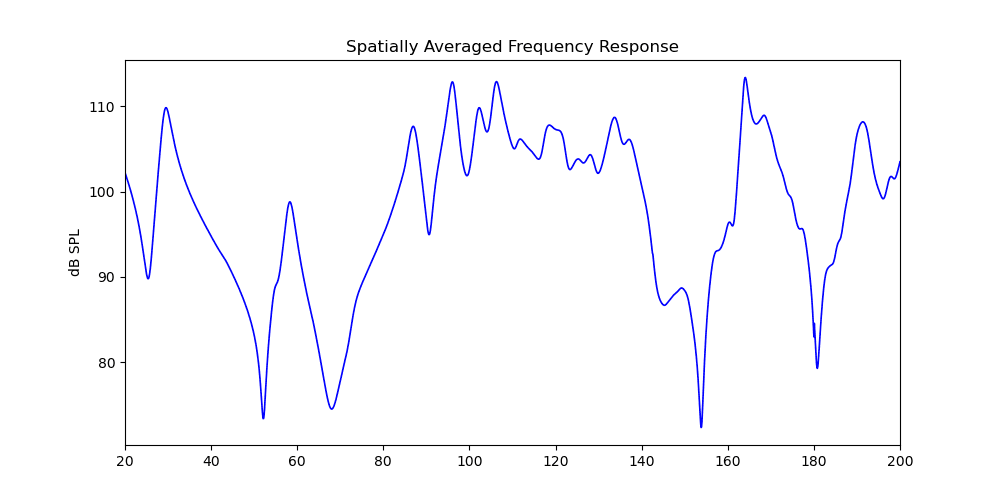
Below 200 Hz the picture changes. The room dimensions of 3m and 5m
correspond closely to the wavelengths of 125 Hz and 63 Hz respectively.
This means the room geometry generates strong resonances at exactly those
frequencies. The spatially averaged frequency response shows peaks and
troughs of nearly 30 dB across the 20 to 200 Hz range. Depending on
where someone sits, bass frequencies either boom or disappear entirely.
It is also worth being honest about the limits of the RT60 metric here.
In a room this size, reverberation time values below 200 Hz become
unreliable because the decay at those frequencies is no longer a clean
exponential. It becomes a complex modal pattern that standard reverberation
calculations cannot accurately capture. The frequency response plot gives
a more truthful picture of what is happening at the low end. This matters
because the low frequency problem and the mid to high frequency problem
need fundamentally different solutions.
Why Treatment Without a Study Falls Short
The simulation reveals two separate problems sitting in the same room.
A severe reverberation time across mid and high frequencies driven by
the almost total absence of absorption on any surface. And strong modal
resonances at low frequencies that conventional absorption panels have
almost no effect on.
Standard acoustic panels, the kind that typically get specified when a
meeting room complaint comes in, are porous absorbers. They perform well
at mid and high frequencies. They do very little at 63 or 125 Hz. Fitting
them without prior analysis will partially address one problem while
leaving the other completely untouched.
There is also the question of how much treatment and where. The same
surface area of material applied to a ceiling performs differently from
the same material on a wall. Different configurations produce different
results at different frequencies. Without a model of the room, these
decisions come down to intuition rather than evidence.
The outcome of that approach is a room that has been treated, still sounds
poor, and has panels on the walls with nowhere obvious to go next.
What the Right Process Looks Like
An acoustic simulation at design stage, or before any treatment is
specified, answers the questions that effective solutions depend on. It
identifies which frequencies are causing problems, where energy is
concentrated, what surface treatments will actually perform at those
frequencies, and what the room will sound like before anything is
purchased or installed.
For the room in this study, addressing mid and high frequency reverberation
would require a combination of a suspended acoustic ceiling and targeted
wall absorption. The low frequency modal behaviour is a separate
conversation entirely, requiring tuned absorbers or geometric consideration
that no standard panel specification would provide.
The cost of a simulation study is a fraction of the cost of getting
treatment wrong and having to revisit it. It is also considerably less
than the ongoing productivity cost of a meeting room that people avoid
using.
The Bottom Line
An untreated glass meeting room of standard dimensions fails on every
acoustic metric relevant to speech. The problems are real, measurable
and entirely predictable with the right tools. They are also solvable,
but only if the diagnosis comes before the treatment.
If you are designing or fitting out an office space with glass meeting
rooms, get in touch for a design stage acoustic review.
Ελληνική Περίληψη
Μοντελοποιήσαμε μια τυπική γυάλινη αίθουσα συσκέψεων 3x5m χωρίς
ακουστική επένδυση. Τα αποτελέσματα έδειξαν χρόνους αντήχησης έως
2.6 δευτερόλεπτα, τετραπλάσιους του στόχου για χώρους ομιλίας, και
σοβαρή υποβάθμιση της ευκρίνειας σε όλο το εύρος των συχνοτήτων
ομιλίας. Το κρίσιμο εύρημα ήταν ότι τα προβλήματα χαμηλών και
υψηλών συχνοτήτων απαιτούν διαφορετικές λύσεις. Η τοποθέτηση
ακουστικών πάνελ χωρίς προηγούμενη μελέτη αντιμετωπίζει μόνο μέρος
του προβλήματος. Η σωστή διαδικασία ξεκινά από τη διάγνωση.
Connect
info@nodeacoustics.com
(+357) 99 718622
" width="89px"><path d="M 45.427 0 C 42.448 0 40.214 2.209 40.214 5.155 C 40.214 8.1 42.448 10.31 45.427 10.31 C 48.405 10.31 50.64 8.1 50.64 5.155 C 50.64 2.209 48.405 0 45.427 0 Z M 21.969 6.628 C 9.681 6.628 0 16.569 0 28.351 C 0 40.134 10.053 50.075 21.969 50.075 C 33.884 50.075 43.937 40.134 43.937 28.351 C 43.937 16.569 34.256 6.628 21.969 6.628 Z M 21.969 42.343 C 14.149 42.343 7.819 36.084 7.819 28.351 C 7.819 20.619 14.149 14.36 21.969 14.36 C 29.788 14.36 36.118 20.619 36.118 28.351 C 36.118 36.084 29.788 42.343 21.969 42.343 Z" fill="rgb(153, 153, 153)" height="50.07531380753138px" id="VSj3XsHuK" transform="translate(22.698 16.216)" width="50.63951740598173px"/><path d="M 62.555 0 L 27.182 0 C 11.915 0 0 11.782 0 26.51 L 0 61.49 C 0 76.218 11.915 88 26.809 88 L 62.182 88 C 77.076 88 88.992 76.218 88.992 61.49 L 88.992 26.51 C 89.364 11.782 77.449 0 62.555 0 Z M 80.8 61.858 C 80.8 71.799 72.608 80.268 62.182 80.268 L 26.809 80.268 C 16.756 80.268 8.192 72.167 8.192 61.858 L 8.192 26.879 C 8.192 16.937 16.383 8.469 26.809 8.469 L 62.182 8.469 C 72.236 8.469 80.8 16.569 80.8 26.879 Z" fill="rgb(153, 153, 153)" height="88px" id="w6VARJ_5D" width="89px"/></g></svg>)
" width="78px"/><path d="M 19.5 24.375 L 19.5 9.75 C 19.5 4.365 15.135 0 9.75 0 C 4.365 0 0 4.365 0 9.75" fill="transparent" height="24.375px" id="bvurMyrXC" stroke-dasharray="" stroke-linecap="round" stroke-linejoin="round" stroke-width="8.73" stroke="rgb(153, 153, 153)" transform="translate(39 34.125)" width="19.500000000000142px"/></g></svg>)
Location
Limassol, Cyprus
Case Study
The Glass Meeting Room: A Simulation Study in Why Diagnosis Comes Before Treatment
We modelled an untreated glass meeting room from the ground up. This is what the data showed, why standard treatment approaches fall short, and what the right process actually looks like.
Glass meeting rooms are one of the most acoustically problematic spaces
in modern office design. They are also one of the most common. When they
perform poorly, the typical response is to add some acoustic panels and
hope the problem improves. It usually doesn't. This simulation study
examines why.
The Study
We built a computational acoustic model of a typical untreated glass
meeting room. 3 metres wide, 5 metres long, glass walls, concrete ceiling,
hard floor. Using a hybrid simulation approach combining pressure acoustics
at low frequencies and geometric ray tracing at mid and high frequencies,
we extracted a full set of acoustic metrics across the audible frequency
range.
The goal was not to confirm that the room sounds bad. That was already
predictable. The goal was to understand precisely what is happening
acoustically and why, because that distinction determines what an effective
solution actually looks like.
What the Data Shows
Reverberation time is well above the target
For a meeting room used primarily for speech, reverberation time should
sit between 0.4 and 0.6 seconds. The simulation returned values between
2.0 and 2.6 seconds across mid and high frequencies. That is roughly four
to five times longer than it should be.
At that level every spoken word overlaps with the decay tail of the
previous one. Speech becomes smeared and increasingly difficult to follow,
particularly on video calls where microphones pick up the reverberant
tail and transmit it to remote participants. The room is actively working
against every conversation held inside it.
Early Decay Time confirms what people feel
Early Decay Time reflects how reverberant a space actually feels to the
people inside it, separate from what the instruments measure. Values in
the simulation rose from around 1.1 seconds at 125 Hz to over 2.2 seconds
at high frequencies. Concert halls designed for a rich enveloping musical
experience are built to those values. A meeting room should not sound like
a concert hall.
Speech definition falls below the threshold for intelligibility
D50 measures the proportion of sound energy arriving within the first
50 milliseconds of a sound event, which ties directly to how well speech
can be understood. Values above 50% are generally considered acceptable
for speech. The simulation returned approximately 40% at 500 Hz, falling
below 30% from 1000 Hz upward. That is the frequency range carrying most
of the information in human speech. The room is failing at exactly the
frequencies that matter most for a conversation.
Low frequencies are a separate problem entirely
Below 200 Hz the picture changes. The room dimensions of 3m and 5m
correspond closely to the wavelengths of 125 Hz and 63 Hz respectively.
This means the room geometry generates strong resonances at exactly those
frequencies. The spatially averaged frequency response shows peaks and
troughs of nearly 30 dB across the 20 to 200 Hz range. Depending on
where someone sits, bass frequencies either boom or disappear entirely.
It is also worth being honest about the limits of the RT60 metric here.
In a room this size, reverberation time values below 200 Hz become
unreliable because the decay at those frequencies is no longer a clean
exponential. It becomes a complex modal pattern that standard reverberation
calculations cannot accurately capture. The frequency response plot gives
a more truthful picture of what is happening at the low end. This matters
because the low frequency problem and the mid to high frequency problem
need fundamentally different solutions.
Why Treatment Without a Study Falls Short
The simulation reveals two separate problems sitting in the same room.
A severe reverberation time across mid and high frequencies driven by
the almost total absence of absorption on any surface. And strong modal
resonances at low frequencies that conventional absorption panels have
almost no effect on.
Standard acoustic panels, the kind that typically get specified when a
meeting room complaint comes in, are porous absorbers. They perform well
at mid and high frequencies. They do very little at 63 or 125 Hz. Fitting
them without prior analysis will partially address one problem while
leaving the other completely untouched.
There is also the question of how much treatment and where. The same
surface area of material applied to a ceiling performs differently from
the same material on a wall. Different configurations produce different
results at different frequencies. Without a model of the room, these
decisions come down to intuition rather than evidence.
The outcome of that approach is a room that has been treated, still sounds
poor, and has panels on the walls with nowhere obvious to go next.
What the Right Process Looks Like
An acoustic simulation at design stage, or before any treatment is
specified, answers the questions that effective solutions depend on. It
identifies which frequencies are causing problems, where energy is
concentrated, what surface treatments will actually perform at those
frequencies, and what the room will sound like before anything is
purchased or installed.
For the room in this study, addressing mid and high frequency reverberation
would require a combination of a suspended acoustic ceiling and targeted
wall absorption. The low frequency modal behaviour is a separate
conversation entirely, requiring tuned absorbers or geometric consideration
that no standard panel specification would provide.
The cost of a simulation study is a fraction of the cost of getting
treatment wrong and having to revisit it. It is also considerably less
than the ongoing productivity cost of a meeting room that people avoid
using.
The Bottom Line
An untreated glass meeting room of standard dimensions fails on every
acoustic metric relevant to speech. The problems are real, measurable
and entirely predictable with the right tools. They are also solvable,
but only if the diagnosis comes before the treatment.
If you are designing or fitting out an office space with glass meeting
rooms, get in touch for a design stage acoustic review.
Ελληνική Περίληψη
Μοντελοποιήσαμε μια τυπική γυάλινη αίθουσα συσκέψεων 3x5m χωρίς
ακουστική επένδυση. Τα αποτελέσματα έδειξαν χρόνους αντήχησης έως
2.6 δευτερόλεπτα, τετραπλάσιους του στόχου για χώρους ομιλίας, και
σοβαρή υποβάθμιση της ευκρίνειας σε όλο το εύρος των συχνοτήτων
ομιλίας. Το κρίσιμο εύρημα ήταν ότι τα προβλήματα χαμηλών και
υψηλών συχνοτήτων απαιτούν διαφορετικές λύσεις. Η τοποθέτηση
ακουστικών πάνελ χωρίς προηγούμενη μελέτη αντιμετωπίζει μόνο μέρος
του προβλήματος. Η σωστή διαδικασία ξεκινά από τη διάγνωση.
Connect
info@nodeacoustics.com
(+357) 99 718622
Location
Limassol, Cyprus