

Insights
What is Flanking Transmission? Why Your Walls Alone Won't Block Sound
You've invested in a solid separating wall, but sound is still getting through. The reason is often flanking transmission. Here's what it is, how it happens, and why it matters for your building.
When people think about sound insulation in a building, they think about walls. Build a thick enough wall between two rooms and the noise stays out. Simple enough in theory; but in practice, sound rarely does what you expect.
This is where flanking transmission comes in. It is one of the most common and most misunderstood reasons why sound insulation underperforms, even in buildings where the separating wall itself is perfectly adequate.
What is Flanking Transmission?
Flanking transmission is when sound travels from one space to another not through the separating wall directly, but around it, via indirect paths through the building structure.
Think of it this way. Sound is vibration. When a sound source creates vibration in one room, that vibration doesn't just hit the wall and stop. It travels into the floor, the ceiling, the structural connections, the ductwork, even the electrical boxes. From there it can re-radiate as sound in the adjacent room, completely bypassing the wall you spent money soundproofing.
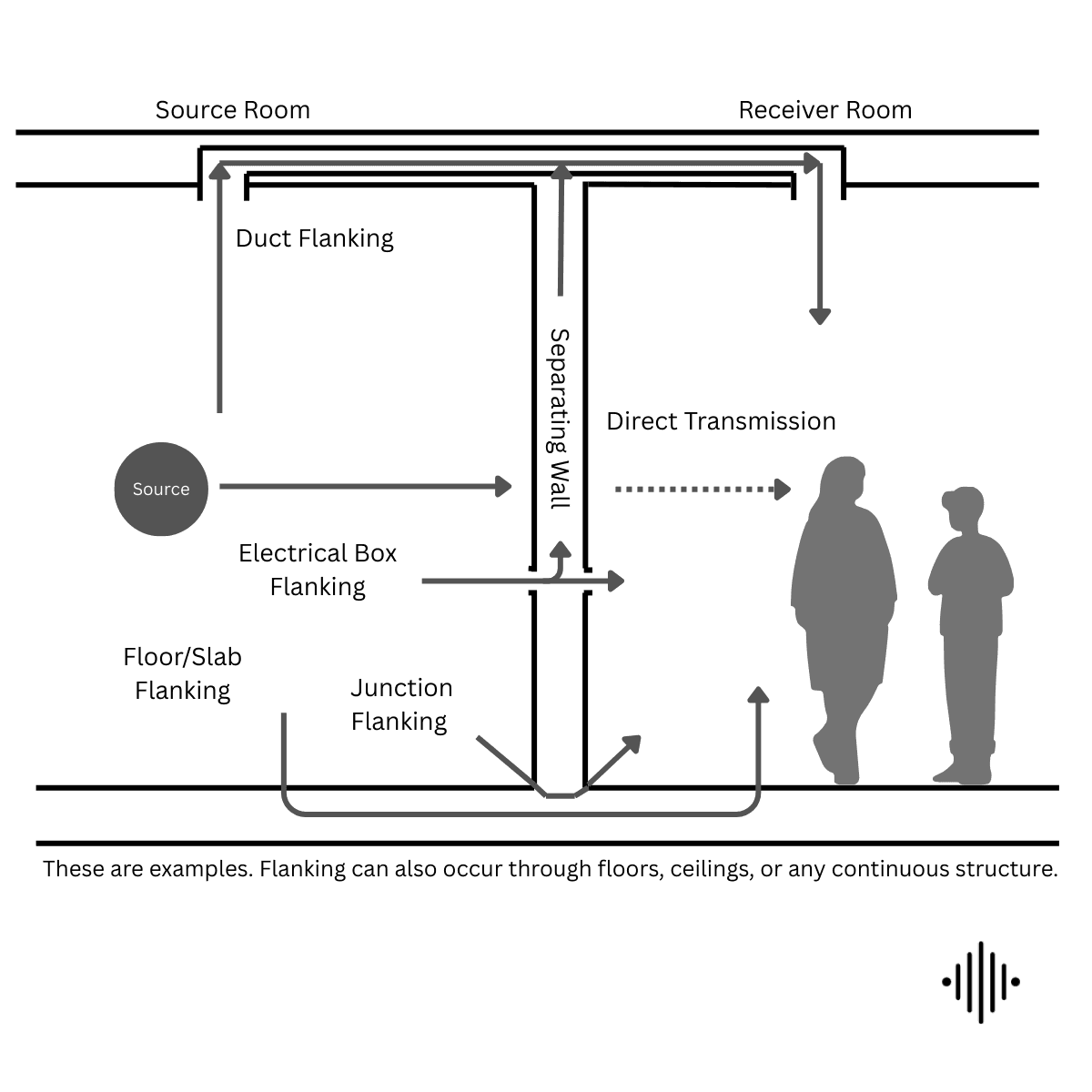
The diagram above shows the most common flanking paths found in buildings:
Direct Transmission is the straightforward path through the separating wall itself. This is what most people try to address and what most soundproofing products target.
Floor and Slab Flanking occurs when vibration travels through the continuous floor structure underneath the wall, re-entering the receiver room from below.
Junction Flanking happens at the point where the separating wall meets the floor or ceiling slab. If these elements are rigidly connected, vibration transfers freely across the junction.
Duct Flanking is particularly common in buildings with shared HVAC systems. Sound travels through the ductwork from one room to another, sometimes across significant distances.
Electrical Box Flanking is easy to overlook. Back-to-back electrical sockets or service penetrations through a separating wall create a direct acoustic weak point.
Why Does it Matter?
Flanking transmission is the reason why a wall with an excellent laboratory sound insulation rating can deliver disappointing results in a real building. The lab measures the wall in isolation. The real building has floors, ceilings, junctions and services all connected to it.
In residential developments, flanking is one of the leading causes of noise complaints between apartments. In hotels, it is why guests can hear their neighbors despite the room appearing well constructed. In schools and offices, it undermines speech privacy and concentration.
The frustrating part is that adding more mass to the wall at this point does very little. If the dominant transmission path is through the floor slab or the ductwork, improving the wall further will have minimal impact.
What Can Be Done About It?
The good news is that flanking transmission is manageable when it is identified and addressed early, ideally at the design stage. Solutions typically involve breaking the structural connections that carry vibration, through the use of resilient layers, isolation mounts, acoustic breaks at junctions, and careful detailing around services and penetrations.
The key word is early. Retrofitting flanking control into a completed building is significantly more disruptive and expensive than designing it in from the start. This is one of the strongest arguments for involving an acoustic consultant during the design phase rather than after problems arise.
How Node Acoustics Can Help
At Node Acoustics, flanking transmission is something we assess as part of every architectural acoustics project. Using detailed modelling and on-site measurement where required, we identify the likely transmission paths in your building and recommend practical, cost-effective solutions before they become a problem.
Ελληνική Περίληψη
Η πλευρική μετάδοση ήχου είναι ένας από τους πιο συχνούς λόγους που η ηχομόνωση σε κτίρια δεν αποδίδει όπως αναμένεται. Ο ήχος δεν διαδίδεται μόνο μέσα από τον διαχωριστικό τοίχο, αλλά και γύρω από αυτόν, μέσα από δάπεδα, οροφές, αγωγούς και δομικές συνδέσεις. Η έγκαιρη αντιμετώπιση του φαινομένου κατά τη φάση σχεδιασμού είναι πολύ πιο αποτελεσματική και οικονομική από οποιαδήποτε μεταγενέστερη παρέμβαση.
Connect
info@nodeacoustics.com
(+357) 99 718622
" width="89px"><path d="M 45.427 0 C 42.448 0 40.214 2.209 40.214 5.155 C 40.214 8.1 42.448 10.31 45.427 10.31 C 48.405 10.31 50.64 8.1 50.64 5.155 C 50.64 2.209 48.405 0 45.427 0 Z M 21.969 6.628 C 9.681 6.628 0 16.569 0 28.351 C 0 40.134 10.053 50.075 21.969 50.075 C 33.884 50.075 43.937 40.134 43.937 28.351 C 43.937 16.569 34.256 6.628 21.969 6.628 Z M 21.969 42.343 C 14.149 42.343 7.819 36.084 7.819 28.351 C 7.819 20.619 14.149 14.36 21.969 14.36 C 29.788 14.36 36.118 20.619 36.118 28.351 C 36.118 36.084 29.788 42.343 21.969 42.343 Z" fill="rgb(153, 153, 153)" height="50.07531380753138px" id="VSj3XsHuK" transform="translate(22.698 16.216)" width="50.63951740598173px"/><path d="M 62.555 0 L 27.182 0 C 11.915 0 0 11.782 0 26.51 L 0 61.49 C 0 76.218 11.915 88 26.809 88 L 62.182 88 C 77.076 88 88.992 76.218 88.992 61.49 L 88.992 26.51 C 89.364 11.782 77.449 0 62.555 0 Z M 80.8 61.858 C 80.8 71.799 72.608 80.268 62.182 80.268 L 26.809 80.268 C 16.756 80.268 8.192 72.167 8.192 61.858 L 8.192 26.879 C 8.192 16.937 16.383 8.469 26.809 8.469 L 62.182 8.469 C 72.236 8.469 80.8 16.569 80.8 26.879 Z" fill="rgb(153, 153, 153)" height="88px" id="w6VARJ_5D" width="89px"/></g></svg>)
" width="78px"/><path d="M 19.5 24.375 L 19.5 9.75 C 19.5 4.365 15.135 0 9.75 0 C 4.365 0 0 4.365 0 9.75" fill="transparent" height="24.375px" id="bvurMyrXC" stroke-dasharray="" stroke-linecap="round" stroke-linejoin="round" stroke-width="8.73" stroke="rgb(153, 153, 153)" transform="translate(39 34.125)" width="19.500000000000142px"/></g></svg>)
Location
Limassol, Cyprus
Insights
What is Flanking Transmission? Why Your Walls Alone Won't Block Sound
You've invested in a solid separating wall, but sound is still getting through. The reason is often flanking transmission. Here's what it is, how it happens, and why it matters for your building.
When people think about sound insulation in a building, they think about walls. Build a thick enough wall between two rooms and the noise stays out. Simple enough in theory; but in practice, sound rarely does what you expect.
This is where flanking transmission comes in. It is one of the most common and most misunderstood reasons why sound insulation underperforms, even in buildings where the separating wall itself is perfectly adequate.
What is Flanking Transmission?
Flanking transmission is when sound travels from one space to another not through the separating wall directly, but around it, via indirect paths through the building structure.
Think of it this way. Sound is vibration. When a sound source creates vibration in one room, that vibration doesn't just hit the wall and stop. It travels into the floor, the ceiling, the structural connections, the ductwork, even the electrical boxes. From there it can re-radiate as sound in the adjacent room, completely bypassing the wall you spent money soundproofing.
The diagram above shows the most common flanking paths found in buildings:
Direct Transmission is the straightforward path through the separating wall itself. This is what most people try to address and what most soundproofing products target.
Floor and Slab Flanking occurs when vibration travels through the continuous floor structure underneath the wall, re-entering the receiver room from below.
Junction Flanking happens at the point where the separating wall meets the floor or ceiling slab. If these elements are rigidly connected, vibration transfers freely across the junction.
Duct Flanking is particularly common in buildings with shared HVAC systems. Sound travels through the ductwork from one room to another, sometimes across significant distances.
Electrical Box Flanking is easy to overlook. Back-to-back electrical sockets or service penetrations through a separating wall create a direct acoustic weak point.
Why Does it Matter?
Flanking transmission is the reason why a wall with an excellent laboratory sound insulation rating can deliver disappointing results in a real building. The lab measures the wall in isolation. The real building has floors, ceilings, junctions and services all connected to it.
In residential developments, flanking is one of the leading causes of noise complaints between apartments. In hotels, it is why guests can hear their neighbors despite the room appearing well constructed. In schools and offices, it undermines speech privacy and concentration.
The frustrating part is that adding more mass to the wall at this point does very little. If the dominant transmission path is through the floor slab or the ductwork, improving the wall further will have minimal impact.
What Can Be Done About It?
The good news is that flanking transmission is manageable when it is identified and addressed early, ideally at the design stage. Solutions typically involve breaking the structural connections that carry vibration, through the use of resilient layers, isolation mounts, acoustic breaks at junctions, and careful detailing around services and penetrations.
The key word is early. Retrofitting flanking control into a completed building is significantly more disruptive and expensive than designing it in from the start. This is one of the strongest arguments for involving an acoustic consultant during the design phase rather than after problems arise.
How Node Acoustics Can Help
At Node Acoustics, flanking transmission is something we assess as part of every architectural acoustics project. Using detailed modelling and on-site measurement where required, we identify the likely transmission paths in your building and recommend practical, cost-effective solutions before they become a problem.
Ελληνική Περίληψη
Η πλευρική μετάδοση ήχου είναι ένας από τους πιο συχνούς λόγους που η ηχομόνωση σε κτίρια δεν αποδίδει όπως αναμένεται. Ο ήχος δεν διαδίδεται μόνο μέσα από τον διαχωριστικό τοίχο, αλλά και γύρω από αυτόν, μέσα από δάπεδα, οροφές, αγωγούς και δομικές συνδέσεις. Η έγκαιρη αντιμετώπιση του φαινομένου κατά τη φάση σχεδιασμού είναι πολύ πιο αποτελεσματική και οικονομική από οποιαδήποτε μεταγενέστερη παρέμβαση.
Connect
info@nodeacoustics.com
(+357) 99 718622
Location
Limassol, Cyprus